The CNAD has processed over 135 DASP applications since the LEAD law took effect, making the role of a reliable crypto license service provider more critical than ever.
The first 50 applicants faced a different world. The regulator was still hiring staff. Review timelines stretched unpredictably. One month, the CNAD wanted three years of financial projections. The next month, they asked for five years. Requirements changed while applications sat in the queue.
Those early applicants absorbed the pain so later ones would not have to.
Today, the CNAD publishes clear timelines. Twenty business days for substantive review. Five business days to correct incomplete submissions. The regulator has seen hundreds of applications. They know what a complete package looks like. They know which business models raise questions. They know which compliance structures pass review.
The firms listed below all submitted applications during that early wave. They watched the CNAD build their processes from the ground up. That experience now lives in their 2026 application templates. New applicants benefit from every mistake those early filers made first.
1. Gofaizen & Sherle
Gofaizen & Sherle started working on crypto licensing in El Salvador before most firms knew the CNAD existed. The firm opened their local office in 2024, during the first wave of DASP applications. That timing was not accidental.
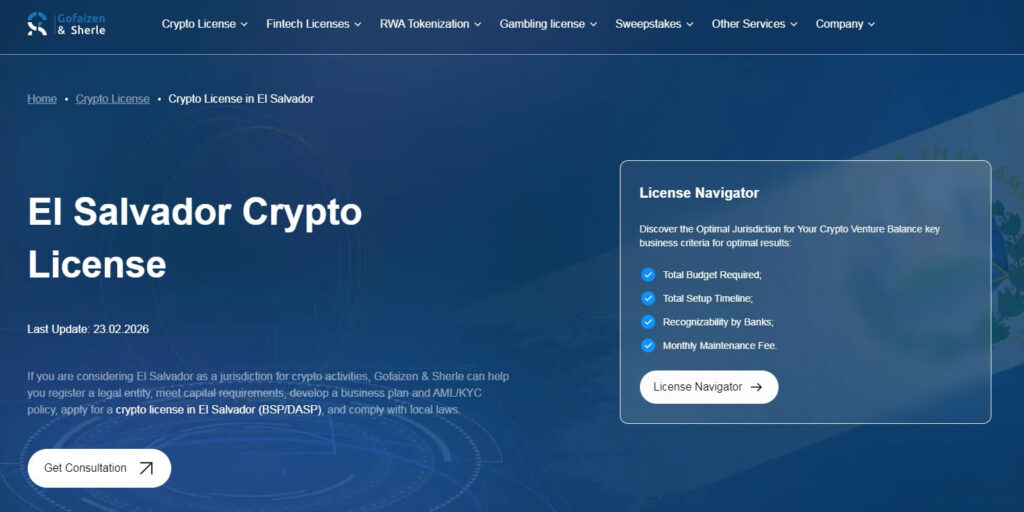
They watched the CNAD figure out their own review process in real time. Document requirements shifted. Clarification questions changed from one month to the next. Gofaizen & Sherle kept records of every single request. That internal database now runs through every new application before submission.
Where they excel:
- Pre-submission screening against past CNAD questions. Every new application gets compared against the firm’s database of clarification requests from previous submissions. If the CNAD asked about a specific policy section last quarter, that section gets expanded before the application goes in. The regulator sees the answer before asking the question.
- Local apostille verification. Documents from outside El Salvador need apostilles from the issuing country. The CNAD rejects documents with incorrect apostille formatting. Gofaizen & Sherle’s local team verifies every apostille against El Salvador’s acceptance criteria before submission. The firm has not had a rejection for this reason in over eighteen months.
- Bank package staging. Salvadoran banks request specific documents from DASP-licensed companies before opening accounts. Gofaizen & Sherle prepares this package during the licensing process. The documents sit ready. When the CNAD issues the license number, the bank application goes out the same day. No waiting weeks to gather paperwork.
The crypto lawyers at Gofaizen & Sherle have supported licensing projects across more than 50 jurisdictions. Their El Salvador practice connects to offices in Europe, Asia, and North America. Clients who want El Salvador now and other markets later do not need to switch firms.
2. Fast Offshore Licenses
Fast Offshore Licenses, a specialized crypto licensing firm, publishes prices like a software company. Basic tier. Fully Operational tier. Complete tier. Each one has a number attached. The website shows the price. A potential client sees the cost before picking up the phone.
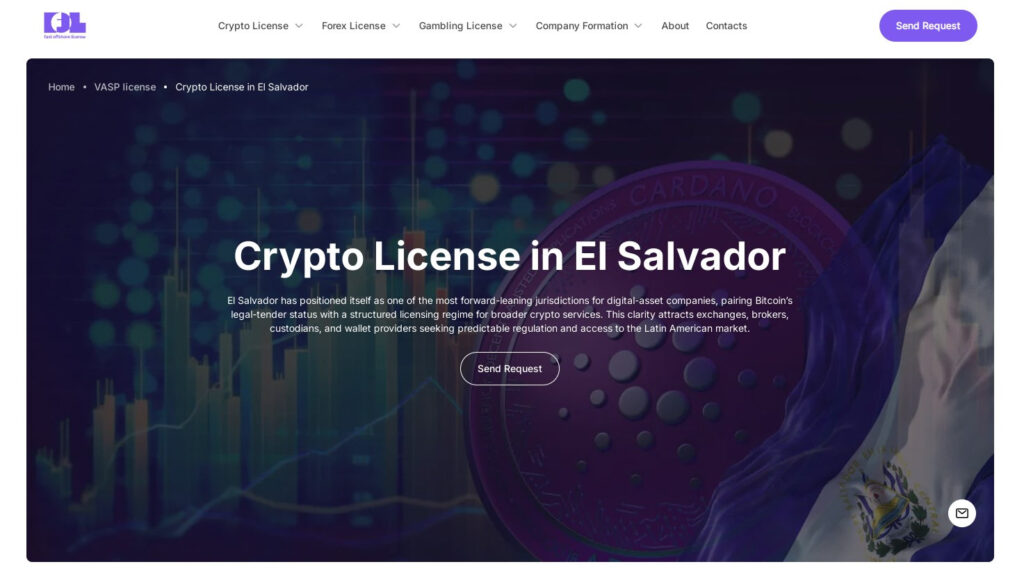
The firm started in traditional offshore jurisdictions. Panama. Cayman Islands. British Virgin Islands. El Salvador entered their portfolio later, but the team has now processed enough applications to break down exactly what each stage costs and how long it takes.
Where they excel:
- BSP-only entry tier. Their Basic package at $12,400 covers only Bitcoin Service Provider registration. Not every crypto business needs full DASP compliance. An exchange trading ten cryptocurrencies needs DASP. A company running a Bitcoin-only payment processor does not. Fast Offshore lets clients pay for the lower tier when that is all they require.
- Stage-by-stage timeline publishing. The firm’s website lists every phase with estimated durations. Two weeks for document collection. Two to three weeks for company registration. Four to six weeks for application preparation. Six to twelve weeks for regulatory review. Total lands at 3.5 to 5.5 months. Clients know what to expect before signing.
- Annual cost breakdown. The website lists $4,000 to $8,000 for regulatory renewal and reporting after the first year. Plus $15,000 or more for transaction monitoring tools and compliance maintenance. The license cost is not the only cost. Fast Offshore puts both numbers on the table.
Fast Offshore provides legal consultants for crypto licensing and legal consulting firm for crypto business services that treat pricing as a feature, not a secret.
3. Tetra Consultants
Most firms celebrate when the CNAD issues the license. Tetra Consultants starts working harder the day after approval.
The firm noticed a pattern across their completed DASP applications. Clients passed the CNAD review but started missing administrative deadlines within six months. Hacienda filings slipped. Social Security payments lagged. Officer certification renewals got forgotten. The license stayed active on paper, but the compliance infrastructure started cracking.
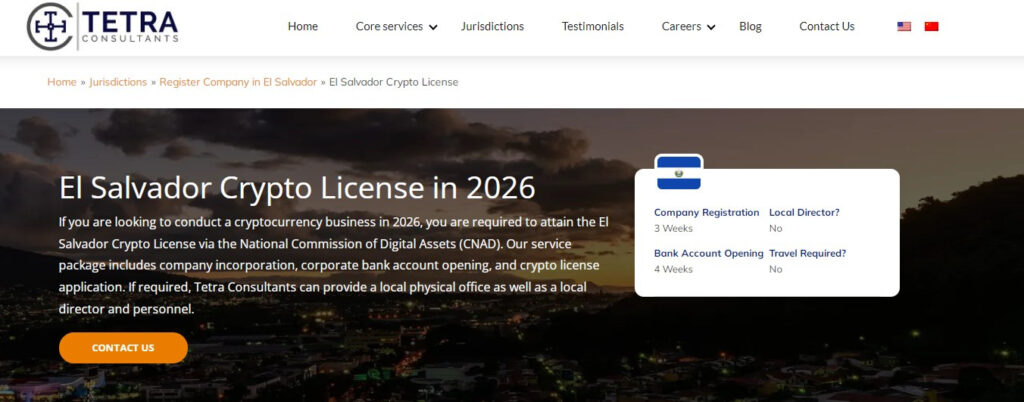
Tetra built their ongoing service package and legal consulting services for crypto business setup to catch those cracks before they spread.
Where they excel:
- Twelve-deadline tracking system. Tetra maps out every regulatory filing requirement for the entire calendar year. Hacienda. Social Security. Ministry of Labor. CNAD. UIF. Each deadline gets logged. The system sends alerts ten days before each due date. Clients do not need to remember anything.
- Officer credential monitoring. The two local compliance officers need annual AML certification renewals. Tetra tracks expiration dates across all clients. When a certification approaches expiry, Tetra enrolls the officer in an approved course. The credential never lapses. An expired officer voids the DASP license.
- Audit document indexing. The CNAD requires an independent compliance audit every twelve months. Most firms scramble to gather documents when the auditor arrives. Tetra pre-indexes everything by month. Transaction logs. SAR filings. Policy update records. Officer meeting minutes. The auditor gets a organized folder, not a box of loose papers.
The lawyers for obtaining crypto license at Tetra also manage the registered agent relationship. El Salvador requires every corporation to maintain a local agent for legal service. Tetra vets the agent, signs the agreement, and ensures the agent’s annual report gets filed. The client does not talk to the agent. Ever.
4. Manimama
Manimama stays in their lane. Crypto exchanges. Crypto wallets. Token projects. That is the entire client list. The firm does not dilute their practice with gambling licenses or forex applications.
Their jurisdiction map covers Lithuania, Poland, Cyprus, Malta, Canada, the UAE, Switzerland, and El Salvador. El Salvador appears in their “fastest registration” category. The firm has seen approvals move quickly there for prepared applicants.
Manimama divides their El Salvador service into Premium, Advanced, and Basic packages. Each tier adds more infrastructure. The Basic package suits Bitcoin-only operations. The higher tiers add full DASP compliance and local officer placement.
Where they excel:
- Industry-specific policy drafting. The firm’s document templates address exchange cold wallet procedures, token issuance compliance, and custodial asset segregation. Generic templates from firms serving multiple industries miss these details. Manimama does not have that problem.
- Startup-friendly entry point. El Salvador has no minimum capital requirement for BSP registration. Manimama markets this advantage directly. Their Basic package reflects the lower compliance burden for Bitcoin-only services.
- Regulatory calendar sharing. Every client gets access to a shared calendar. Hacienda filing dates. Social Security payment deadlines. CNAD quarterly report due dates. The calendar sends alerts seven days before each deadline. Clients never ask “what is due next month.”
Manimama acts as a specialized legal firm for obtaining crypto license that treats El Salvador as one jurisdiction in a larger European expansion map. Their EU base means clients can handle MiCA compliance and the DASP application through the same firm.
5. Intelligent Solution Group (ISG Consulting)
ISG Consulting starts at 26,200 USD for their El Salvador crypto license package. That number includes company registration, document preparation, compliance system development, and CNAD submission.

The firm published a verified case study on their website. A client needed to operate a crypto exchange and crypto processing service in a jurisdiction where cryptocurrency is recognized as legal tender. ISG proposed El Salvador. Four months later, the client had a registered company, a corporate bank account, approved AML/KYC policies, and an active DASP license.
Where they excel:
- Four-month documented track record. The case study breaks down the actual timeline. Not a projection. Not a best-case scenario. Four months from start to license approval, including company registration, bank account opening, policy development, and CNAD review.
- Post-license banking and payment connections. After the license arrived, ISG connected the client’s corporate bank account to crypto payment solutions. The client launched an exchange and processing service with international capabilities immediately, not weeks later.
- Local AML officer service. ISG offers monthly local AML officer support as a paid add-on. The DASP license requires this role. ISG provides the officer so clients do not need to find and hire someone on their own.
- Neobank account opening. Beyond traditional Salvadoran banks, ISG opens accounts with neobanks as a separate service. That gives clients options when local banks push back on crypto businesses.
- Complete due diligence package. The firm runs checks on all directors, shareholders, and ultimate beneficial owners before submission. The CNAD requires this. ISG delivers the verification package as part of the license application.
The legal consulting services for crypto business setup at ISG also include business plan approval assistance. The firm notes that business plan approval was one of the difficulties in their case study. They resolved it by bringing in local consultants and lawyers who knew what the CNAD wanted to see.
ISG positions El Salvador as a strategic entry point for crypto projects focused on sustainable development and international partnerships. Their published price starts at 26,200 USD, but the final cost depends on the complexity of the company structure and the quality of documents provided.
Best for: Crypto exchanges and payment processors that want a documented four-month track record, verified case study results, and optional monthly local AML officer support.
Where Each Firm Fits
Gofaizen & Sherle catches problems before submission. Their local office verifies every apostille. The CNAD has not rejected one of their documents for bad formatting in over eighteen months.
Fast Offshore Licenses puts every number on the website. Pricing. Timelines. Annual maintenance. Their Basic tier at $12,400 covers Bitcoin-only operations. Clients do not pay for DASP compliance they do not need.
Tetra Consultants delivers legal crypto consulting that works the hardest the day after approval. Automated filing reminders. Officer certification tracking. Audit document indexing. Most firms celebrate. Tetra keeps filing.
Manimama never touches gambling licenses or forex applications. Every client runs a crypto business. Exchanges. Wallets. Token issuers. Their templates address cold storage and token distribution. The CNAD sees the focus.
Intelligent Solution Group has a verified four-month case study on their website. A client went from zero to a licensed exchange and processing service. The firm also offers monthly local AML officer support as a paid add-on.
Pick the firm that matches your business. Bitcoin-only operation? Fast Offshore. Multi-country expansion? Gofaizen & Sherle. Heavy admin load? Tetra. Pure crypto focus? Manimama. Verified four-month track record? Intelligent Solution Group.
All seven have submitted applications recently. All seven know what the CNAD asks for in 2026. The difference is how they deliver.
Conclusion
El Salvador has issued over 135 DASP authorizations since the LEAD law took effect. The CNAD processes applications on a published schedule now. Twenty business days for review. Five business days for corrections. The regulator knows what it wants.
The 2025 Bitcoin Law amendments changed mandatory BTC acceptance rules. But those changes did not touch the LEAD legislation. The DASP framework stayed intact. The 0% corporate tax rate on digital asset income remains active under Article 36.
Tether relocated its headquarters to El Salvador. Bitfinex Securities operates from San Salvador. The market is not waiting. Neither should you.
Gofaizen & Sherle, Fast Offshore Licenses, Tetra Consultants, Manimama, and Intelligent Solution Group have all submitted applications recently. Each firm has seen the CNAD’s current review patterns. Each one knows which documents get flagged and which sail through.
The choice comes down to your specific needs. Local office presence? Gofaizen & Sherle has one. Bitcoin-only operation? Fast Offshore offers a lower-cost BSP tier. Ongoing administrative support? Tetra handles the post-license load. Crypto-only focus? Manimama never touches non-crypto clients. Verified four-month track record? Intelligent Solution Group delivers with a published case study.
Pick the legal service to obtain a crypto license that matches your business model. But pick one. The CNAD is not slowing down. Neither should you.